The hidden gastronomy of the Pyrenees
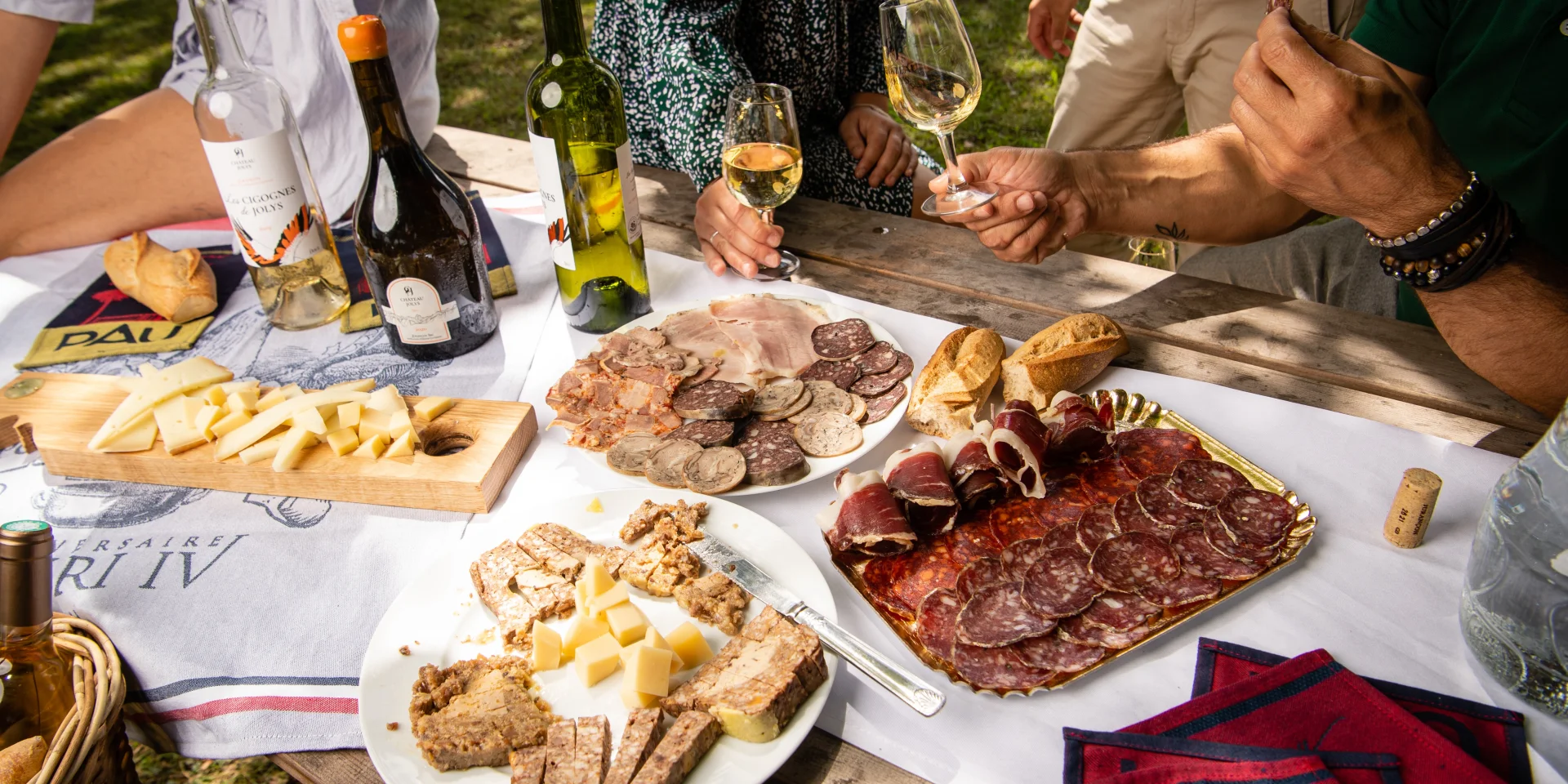
Understanding gastronomy in the Pyrenees requires a slight shift in perspective.
What you are looking at is not simply a regional cuisine built around emblematic dishes. It is a food system structured by geography, altitude, and movement, where production methods are still closely tied to the landscape.
This is what makes it particularly interesting today. In many parts of Europe, food has gradually detached from its environment. In the Pyrenees, that link still holds — and it can still be observed.
A fragmented territory that produces different food systems
The Pyrenees are not a single environment. They form a succession of valleys, each with its own climatic conditions, exposure, and agricultural potential.
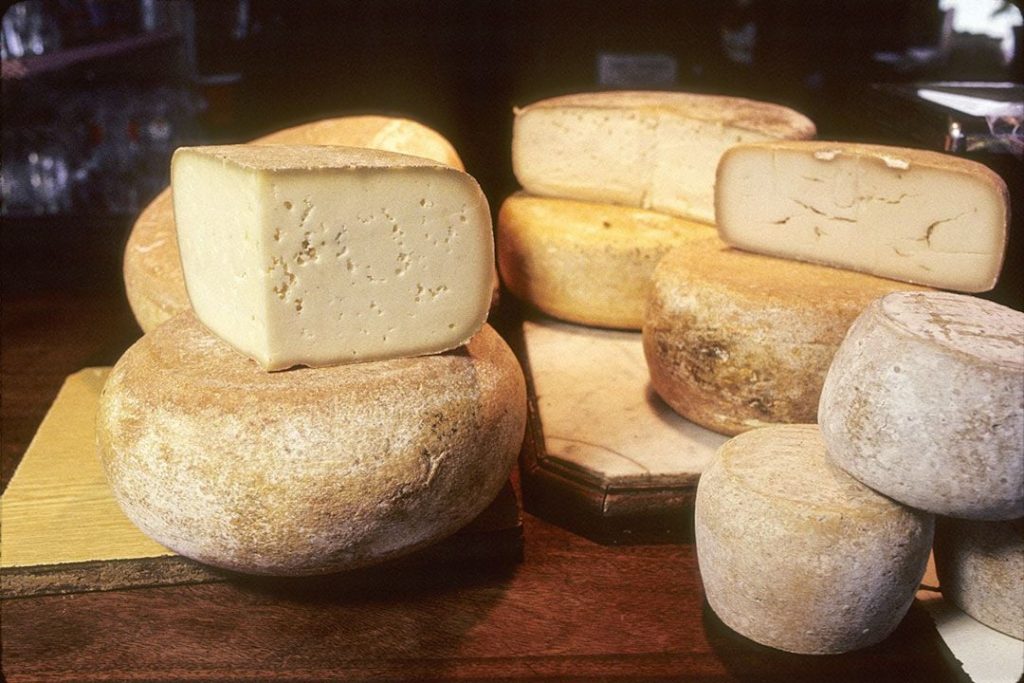
On the Atlantic side, particularly in Béarn and the Basque Pyrenees, humidity allows grass to grow for extended periods. This creates favorable conditions for pastoral systems based on sheep, which explains the importance of cheeses such as Ossau-Iraty (AOP).
Further inland, where the climate becomes more continental, winters are longer and vegetation cycles are shorter. In these areas, food systems have historically relied more on preservation techniques. This is where you find dishes such as garbure, designed to make use of ingredients that could be stored and used over time.
This geographical fragmentation means that gastronomy in the Pyrenees is not uniform. It varies from one valley to another, often over relatively short distances.
Altitude and vegetation: direct impact on taste
Altitude is one of the most decisive factors in the Pyrenean food system.
When animals are kept in the valley, their diet is relatively stable and based on cultivated or low-altitude vegetation. When they are moved to higher pastures — the estives, typically located between 1,200 and 2,000 meters — their diet becomes significantly more diverse.
These pastures include wild grasses, flowers, and aromatic plants that do not grow at lower altitudes. This diversity directly affects the composition of the milk, altering its fat content, aromatic complexity, and texture.
As a result, cheeses such as Ossau-Iraty vary not only from one producer to another, but also from one period of the year to another.
This variability is not incidental. It is intrinsic to the system.
Transhumance as a structural mechanism
The seasonal movement of livestock between valleys and high-altitude pastures — known as transhumance — is central to the functioning of this system.
Rather than being a symbolic or traditional practice, transhumance is a response to how vegetation evolves throughout the year.
During summer, valley grass becomes less nutritious due to heat and reduced water availability. Higher up, vegetation remains more suitable for grazing because of lower temperatures and later snowmelt.
Moving herds is therefore essential to maintain both animal health and product quality.
This movement introduces a temporal dimension into gastronomy. Products are not fixed. They evolve depending on when they are produced and where animals have been grazing.
Time as a production variable
In the Pyrenees, time plays a functional role in food production.
Slow cooking methods, such as those used for garbure, allow for the transformation of ingredients that would otherwise be difficult to use. They maximize nutritional extraction and allow for efficient use of available resources.
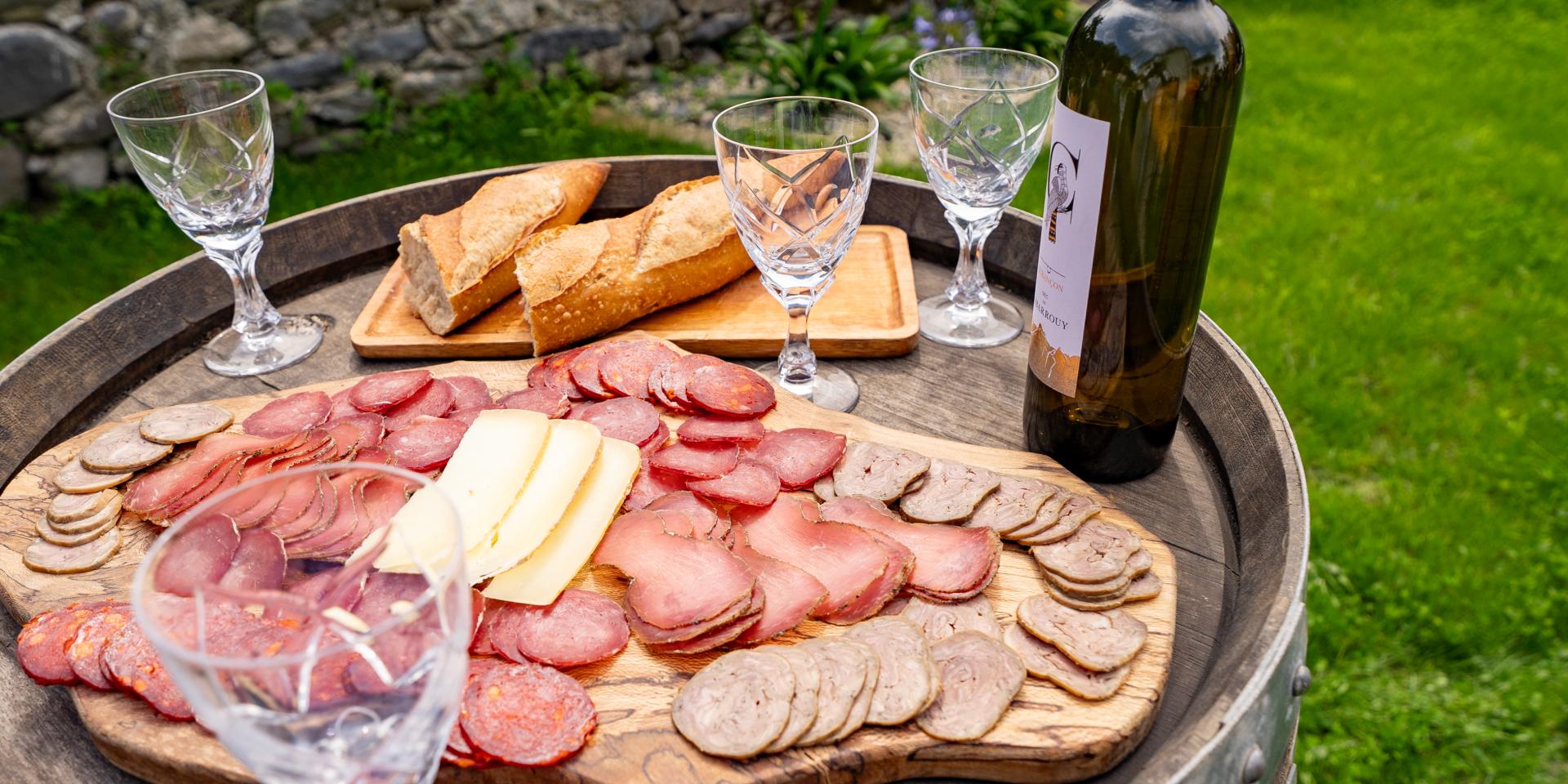
Similarly, curing and aging processes are influenced by the mountain environment. Products such as Noir de Bigorre pork (AOP) depend on extended growth periods, outdoor rearing, and natural feeding. These factors contribute to the structure and flavor of the meat.
Even aging conditions for cheese or cured products are affected by altitude, humidity, and air circulation, which vary across the territory.
From understanding to experience
What makes the Pyrenees particularly relevant today is that these mechanisms are still visible.
Pastoral practices continue in many valleys. Transhumance still takes place. Small-scale production remains present, and in some cases dominant.
This means that gastronomy here is not only something to taste, but something that can be observed and understood directly in the landscape.
This is also the approach taken in a number of terroir and gastronomy-focused journeys developed across the Pyrenees.
Rather than isolating food as a separate activity, these experiences integrate it into a broader movement through the territory. For example, certain itineraries between Béarn and the Basque Country combine cycling or walking with encounters with local producers, tastings, and meals that reflect the areas being crossed.
Other experiences focus on immersion in pastoral environments, such as spending time in the estives with a shepherd, observing how milk is produced, how cheese is made, and how seasonal cycles influence production.
In these contexts, gastronomy is not presented as a curated tasting. It is approached as the result of a system that can be explored progressively, through movement and observation.
A system that remains coherent
The persistence of these practices is what gives Pyrenean gastronomy its coherence.
Because production remains closely tied to environmental conditions, food retains a strong link to place. Products are not interchangeable, and they cannot be fully understood outside of the context in which they are produced.
This is particularly relevant in a context where many food systems have become standardized. In the Pyrenees, variability is still present, and it is directly linked to the territory.
Gastronomy in the Pyrenees is not defined by a set of iconic dishes.
It is defined by relationships — between altitude and vegetation, between movement and production, between time and transformation.
Understanding these relationships provides a clearer reading of what is on the plate.
And in a territory where these dynamics are still active, the most direct way to understand them is not through explanation alone, but through experience — by moving through the valleys, observing how production is organized, and encountering the people who maintain these systems.
This is where the logic of Pyrenean gastronomy becomes visible.
And where it starts to make sense.
Photo credits: Tourisme Pau / Pyrénées Béarnaises / Explore France